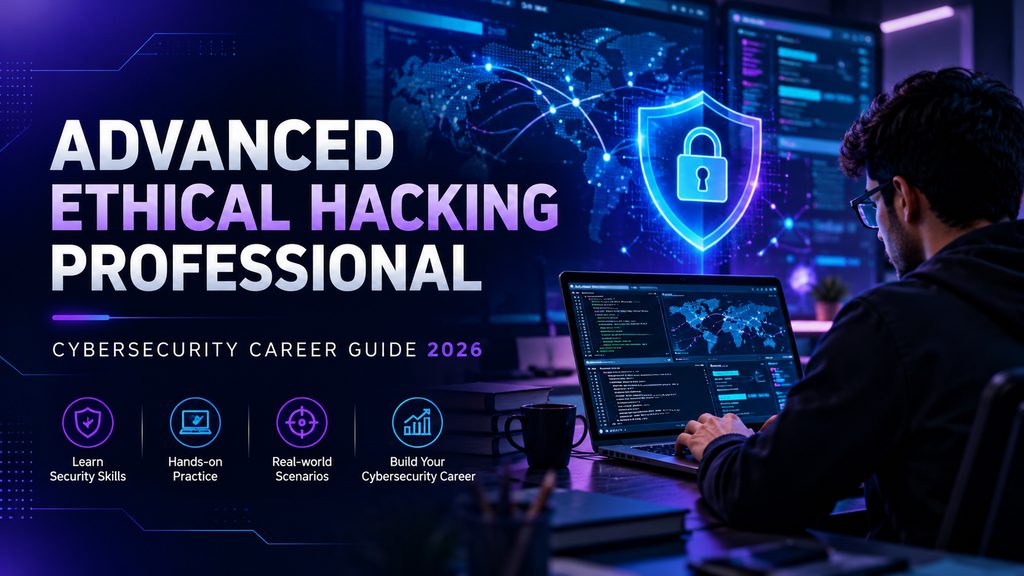
Advanced Ethical Hacking Professional (AEHP): Complete Cybersecurity Career Guide for 2026
Cybersecurity has become a critical priority for businesses, governments, and organizations that depend on digital systems. As cyber threats continue to evolve, organizations need skilled professionals who can identify vulnerabilities, assess security risks, and strengthen their defenses.
The Advanced Ethical Hacking Professional (AEHP) course is designed for learners who want to develop practical cybersecurity skills through theoretical learning, hands-on exercises, and real-world security scenarios.
In this guide, we will explore ethical hacking, essential cybersecurity skills, practical training areas, career opportunities, and how structured professional training can help you build a foundation in information security.
What Is Ethical Hacking?
Ethical hacking is the authorized process of assessing computer systems, networks, and applications to identify security weaknesses before malicious attackers can exploit them.
Ethical hackers work within an approved scope and follow defined rules of engagement. Their objective is to help organizations understand their security risks and implement effective solutions.
Common ethical hacking activities include:
- Identifying vulnerabilities in systems and applications.
- Assessing network security and access controls.
- Evaluating web application security.
- Reviewing security configurations.
- Documenting findings and recommending remediation.
- Helping organizations improve their overall security posture.
Ethical hacking must always be performed with explicit authorization and within the agreed testing scope.
Why Learn Advanced Ethical Hacking?
Organizations need cybersecurity professionals who understand both how attacks occur and how to prevent them.
Learning ethical hacking can help you:
- Develop a strong foundation in cybersecurity.
- Understand network protocols and common security weaknesses.
- Learn vulnerability assessment and penetration testing methodologies.
- Improve your understanding of web application security.
- Practice security analysis in controlled lab environments.
- Develop technical reporting and problem-solving skills.
- Prepare for entry-level and advanced cybersecurity learning paths.
For students, IT professionals, and aspiring security analysts, practical cybersecurity training can provide a structured way to explore this growing technical field.
Important Skills Covered in Ethical Hacking Training
1. Networking Fundamentals
Networking knowledge is essential for understanding how systems communicate and where security weaknesses may occur.
Study IP addressing, TCP/IP, DNS, ports, routing, firewalls, and common network protocols.
2. Linux and Operating System Security
Learn how operating systems manage users, permissions, services, processes, and logs. Familiarity with Linux command-line tools is especially useful in cybersecurity labs.
3. Reconnaissance and Information Gathering
Understand how authorized security assessments collect information about an organization’s approved testing environment. Learn to distinguish passive information gathering from active testing and follow the agreed scope.
4. Vulnerability Assessment
Learn how to identify, classify, and prioritize security weaknesses. Understand the difference between a potential vulnerability, a validated finding, and a confirmed security risk.
5. Web Application Security
Explore common web security issues such as injection vulnerabilities, authentication weaknesses, access-control failures, and insecure configurations.
Study the OWASP Top 10 as a starting point for understanding major web application security risks.
6. Penetration Testing Methodology
Learn how authorized penetration tests are planned, conducted, documented, and concluded. Understand scope definition, evidence collection, impact assessment, and responsible reporting.
7. Digital Forensics and Incident Response
Develop an understanding of security logs, incident investigation, evidence preservation, and incident response procedures. These skills can help you understand how organizations detect and investigate suspicious activity.
8. Security Reporting and Remediation
Technical testing is only one part of cybersecurity work. Learn to communicate findings clearly, explain business impact, prioritize remediation, and recommend practical defensive measures.
The precise modules and tools included in AEHP should be confirmed against the current IEMLabs course syllabus.
Popular Tools Used in Cybersecurity Learning
Security professionals use different tools depending on the assessment, environment, and authorization provided.
- Nmap: Network discovery and service enumeration.
- Wireshark: Network traffic analysis and protocol inspection.
- Burp Suite: Web application security testing.
- OWASP ZAP: Web application security assessment.
- Linux security tools: Command-line utilities for system analysis and troubleshooting.
- SIEM platforms: Security event collection, correlation, and monitoring.
Use these tools only on systems you own or have explicit permission to assess. Practice in intentionally vulnerable applications, isolated virtual machines, or approved training environments.
How to Start Learning Ethical Hacking
Step 1: Build Your Technical Foundation
Learn networking, Linux, operating system fundamentals, and basic scripting. Python can be particularly useful for automation and security analysis.
Step 2: Understand Security Principles
Study authentication, authorization, encryption, secure configuration, common attack patterns, and defensive security practices.
Step 3: Practice in Controlled Labs
Use legal training platforms and isolated lab environments to explore vulnerabilities without affecting real systems.
Step 4: Learn a Structured Testing Methodology
Follow a consistent process: define scope, gather information, validate findings, assess impact, document evidence, and recommend fixes.
Step 5: Build a Cybersecurity Portfolio
Create lab reports, document defensive projects, analyze sample security logs, and demonstrate how you identified and addressed security weaknesses.
Never publish confidential information or details from assessments that you are not authorized to disclose.
Step 6: Prepare for Interviews
Practice explaining network security, web vulnerabilities, incident response, vulnerability prioritization, and the difference between ethical hacking and malicious activity.
Practical Projects to Strengthen Your Cybersecurity Skills
Hands-on projects help translate theoretical concepts into demonstrable skills.
Project 1: Build a Cybersecurity Lab
Create an isolated virtual environment with a test machine and an intentionally vulnerable target. Document the lab architecture and safety boundaries.
Project 2: Analyze Network Traffic
Capture sample traffic in a controlled environment and use Wireshark to identify protocols, communication patterns, and unusual activity.
Project 3: Assess a Test Web Application
Use an approved training application to study common web vulnerabilities, validate findings, and document appropriate remediation steps.
Project 4: Create a Security Assessment Report
Prepare a sample report containing the assessment scope, findings, severity, potential impact, evidence, and recommended fixes.
Project 5: Develop a Basic Log Analysis Tool
Use Python to parse sample authentication logs and flag repeated failed login attempts for further investigation.
These projects can help demonstrate analytical thinking, technical documentation, and practical cybersecurity knowledge.
Career Opportunities After Ethical Hacking Training
Cybersecurity training can support several career paths, depending on your skills, experience, and qualifications.
Potential roles include:
- Junior Penetration Tester
- Vulnerability Assessment Analyst
- Security Analyst
- Security Operations Center (SOC) Analyst
- Information Security Analyst
- Application Security Tester
- Cybersecurity Consultant
Employers may also look for networking knowledge, operating system administration, scripting, communication skills, and practical experience. Completing a course does not automatically guarantee employment.
How IEMLabs Can Help You Develop Cybersecurity Skills
IEMLabs presents its Advanced Ethical Hacking Professional course as a practical learning program that combines theoretical foundations with hands-on security exercises.
The course page highlights intermediate-to-advanced learning, practical training, security tools, certification upon completion, online and offline classes, mock interviews, and résumé-building support.
The displayed course duration is 60 hours. Confirm the current schedule, available delivery options, certification details, and included training activities directly with IEMLabs before enrolling.
A structured training program, combined with independent lab practice and portfolio development, can help learners work toward cybersecurity career goals.
Conclusion
Ethical hacking is an important part of modern cybersecurity because it helps organizations identify weaknesses before those weaknesses lead to serious security incidents.
By learning networking, Linux, vulnerability assessment, web application security, penetration testing methodology, and security reporting, you can develop a strong foundation for further cybersecurity study.
Focus on authorized practice, build demonstrable projects, and learn to communicate findings responsibly. These habits are essential for anyone pursuing a professional career in information security.
Ready to strengthen your cybersecurity skills? Explore the Advanced Ethical Hacking Professional training options at IEMLabs and take the next step toward your cybersecurity learning goals.
Frequently Asked Questions
What is the Advanced Ethical Hacking Professional course?
AEHP is presented by IEMLabs as a cybersecurity training course focused on ethical hacking concepts, practical exercises, security tools, and professional development.
Is ethical hacking suitable for beginners?
Yes, although learners benefit from understanding networking, operating systems, and basic cybersecurity concepts before progressing to advanced topics.
Do I need programming skills to learn ethical hacking?
You can begin with limited programming experience, but Python, scripting, and basic web development knowledge can help you automate tasks and understand application vulnerabilities.
Is ethical hacking legal?
Ethical hacking is legal when performed with appropriate authorization and within the agreed scope. Testing systems without permission can violate laws and organizational policies.
What jobs can I pursue after cybersecurity training?
Depending on your practical skills and experience, you may pursue roles such as junior penetration tester, SOC analyst, vulnerability assessment analyst, or information security analyst.
How can I practice ethical hacking safely?
Use isolated virtual machines, intentionally vulnerable training applications, and platforms that explicitly authorize security testing. Never test public systems without permission.